Trading meme coins with a $10 bankroll works better when you treat fees and position size as the strategy
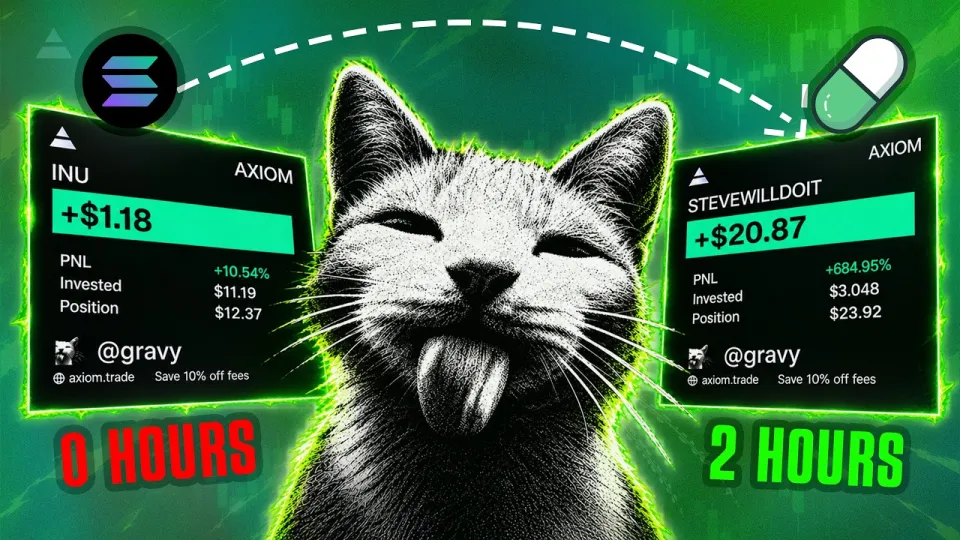
Video: I Tried Trading Memecoins with Just $10
Want articles like this for your own video to promote it on YouTube and Google? Order them through the Telegram bot @sat_sit_bot. It writes articles around your video, embeds the video and publishes them on popular niche websites (no ads). Try it free: 50 articles on us.
· based on the channel gravy
Meme coin trading with a $10 bankroll is possible, but only if you size every position so that fees and slippage stay a small fraction of the trade — in the «gravy» experiment, five buys on Solana each stayed under 0.05 SOL, and the outcome depended far more on narrative timing than on the size of the account. You can follow the same route through Axiom, where the referral link gives cashback and reduced fees.
The premise is simple: everyone repeats that small portfolios get eaten alive by gas, priority fees and swap taxes, so the test was to run real money through the same workflow a larger trader would use and see whether the math holds up.
What $10 actually buys you in meme coin trading
A $10 account is not a handicap in itself — the real constraint is the fixed cost per trade. On Solana, a swap carries a base network fee, an optional priority fee to land in a crowded block, a platform fee (Pump.fun-style launches and aggregators each take their cut) and slippage against thin liquidity. On a $10 position, a 1% platform fee plus 1–2% slippage plus a few cents of priority fee can quietly consume 5–10% of the trade before the price moves at all. That means the round trip needs roughly a 10–20% move just to break even, which is why the practical rule for small balances is fewer, higher-conviction trades rather than rapid scalping.
A useful way to think about it:
- Cap each buy at a fixed slice of the bankroll — in the video, 0.05 SOL per trade.
- Prefer tokens with enough liquidity that a small order does not move the price against you.
- Count the round trip cost before entering, not after exiting.
- Treat the first trade as tuition, not as income.
The five trades and what each one teaches
The experiment covered five positions, and each one illustrates a different part of the meme coin playbook. STEVEWILLDOIT was the opening trade, built on a name-driven narrative rather than a product. NPC followed as a pure culture meme, the kind of coin whose price depends entirely on whether the joke keeps spreading. MET (Meteora) was the closest thing to an infrastructure-adjacent bet, tied to a real Solana project rather than a character. PUMPY the Trader leaned on the Pump.fun launch culture that supplies most new Solana meme coins. UNTXD was the trade the host admits fumbling — a reminder that execution errors, not market direction, are the most common way small accounts lose money.
The pattern across all five is that entry timing around a narrative mattered more than the token's technical setup. None of these were long-term holds; they were short exposures to attention.
Why narrative beats chart patterns on small accounts
Meme coin prices are driven by attention, so the skill that pays is recognising which story is currently spreading. The X Money coin meta described in the video is a clean example: it ran because of the e/acc and Cream crowd amplifying a specific narrative, not because of tokenomics or revenue. Traders who understood why the story was circulating could position early; traders who arrived after the timeline was saturated bought the top.
A practical narrative checklist for a small portfolio:
- Identify the specific catalyst — a person, a product launch, an inside joke with a visible origin.
- Check whether the story is still spreading or already everywhere; saturation is the sell signal.
- Watch who is amplifying it, since a narrative carried by accounts with real reach behaves differently from one carried by bots.
- Decide your exit before you enter, because meme coins rarely give you a second chance to think clearly.
Position sizing, fees and the referral math
Fee structure is the part beginners skip, and it is the part that decides whether a $10 experiment is viable. Aggregator and launchpad fees are charged on both legs of a trade, priority fees are paid per transaction, and slippage scales with how thin the pool is. Using a referral that returns cashback or discounts fees directly improves the break-even point — Axiom advertises 2x cashback and 15% lower fees through referral links, which on a small account is the difference between a marginal strategy and a losing one.
Three rules that follow from the math:
- Never let total round-trip cost exceed a small single-digit percentage of the position.
- Avoid tokens where your order size is a meaningful share of the pool.
- Track results per trade, including fees, because a green trade can still be a net loss after costs.
The questions small-portfolio traders keep asking
The most common doubts around this approach are consistent. Traders struggle to keep up with the volume of information needed to spot narratives — reading every post, remembering who has influence, and tracking which communities are genuinely active. Others describe the classic pattern of buying a dip that never recovers, or selling at a 20–40% loss only to watch the coin run higher afterwards. Both problems come from entering without a defined thesis and exit, not from the size of the account.
A second recurring question is how to curate an information feed so it surfaces early narratives instead of noise. The practical answer is to follow a small set of accounts that consistently post before a story goes mainstream, mute the rest, and accept that you will miss most coins — you only need a few good entries. A third is whether a small balance should be traded live at all; the video closes by asking viewers whether to run a doxxed wallet from 0.1 SOL or 1 SOL, which is exactly the right way to scale up: prove the process on the smallest amount that still produces real emotional stakes.
Useful links
- Trade on Axiom with the referral
- The Trenches Discord
- Discord with free Axiom imports and trade signals (NFA)
- gravy on X
- Leverage trading with 20% futures fee reduction
Bottom line
Trading meme coins with $10 is viable as a learning process, not as a fast path to profit: the fees are real, the narratives move faster than most people can track, and the edge comes from disciplined position sizing and early recognition of attention shifts. The five-trade experiment from the «gravy» channel shows that a sub-0.05 SOL buy can still be a meaningful test of process, and that the biggest losses usually come from execution mistakes rather than bad luck. Anyone repeating it should start on the smallest live amount, keep a per-trade record including fees, and scale only after the process is consistent. If you want the same fee structure used in the video, start with the Axiom referral link and treat the cashback as a buffer against the round-trip cost.
Key takeaways
- Five real trades on Solana, each buy capped at 0.05 SOL — roughly $10 at recent SOL prices.
- Trades covered: STEVEWILLDOIT, NPC, MET (Meteora), PUMPY the Trader and UNTXD.
- The X Money coin meta ran on e/acc and Cream narratives, not on fundamentals.
- Referral trading on Axiom advertises 2x cashback and 15% lower fees.
- The host asks viewers whether to live trade a doxxed wallet from 0.1 SOL or 1 SOL.
Questions & answers
Can you really trade meme coins with only $10?
Yes, technically — the constraint is cost per trade, not the balance itself. With a $10 position, platform fees, priority fees and slippage can consume a large share of the trade, so you need to pick liquid tokens and avoid rapid scalping. The experiment in the video used buys under 0.05 SOL and still produced meaningful lessons.
How do I find meme coins with good narratives before everyone else?
Follow a small set of accounts that consistently post before a story goes mainstream, and check whether a narrative has a visible origin — a person, launch or inside joke. Saturation is the signal to exit, not enter. You will miss most coins, and that is fine; a few early entries carry the results.
Why do I keep selling at a 20–40% loss and then watch the coin recover?
That usually means the position was entered without a defined thesis or exit level, so the drawdown triggers an emotional decision. Decide in advance what would invalidate the trade and what price takes profit, and size the position so a normal pullback does not force you out.
Should a beginner trade a small balance live or keep practising on paper?
Start live with the smallest amount that still creates real emotional stakes, because paper trading does not reproduce the pressure of a real position. Keep a record of every trade including fees, and scale up only after the process is repeatable.
Source: I Tried Trading Memecoins with Just $10 · Markdown version